

Cementless Hip Replacement
What Is Cementless Hip Replacement?
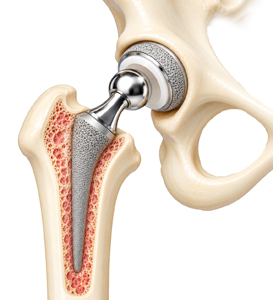
Cementless hip replacement replaces the damaged ball and socket of your hip with artificial components that are held in place by a press fit and, over time, by new bone growth rather than by cement. It is one way of fixing the implants during a total hip replacement.
In a total hip replacement, the worn cartilage and bone are removed and replaced with a metal socket (with a plastic, ceramic or metal liner), a stem placed in the thighbone (femur) and a ball that sits on the stem. With a cementless approach, the socket and stem are sized to fit snugly into the prepared bone. Their textured or porous surfaces encourage your bone to grow into and around them, which is how the long-term bond forms.
Am I a Candidate for Cementless Hip Replacement?
You may be a candidate if hip arthritis or joint damage causes ongoing pain and stiffness that no longer respond to conservative treatment, and your bone is strong enough to support new bone growth onto the implant. The final decision depends on a full evaluation with Dr. Feign.
Factors we consider include:
- Hip pain that limits daily life: Pain that makes walking, climbing stairs, sleeping or getting in and out of a car difficult.
- Failed conservative care: Medications, physical therapy, activity changes or injections that no longer provide enough relief.
- Bone quality: Healthy, dense bone that can grow onto the implant surface.
- Your anatomy: The shape and size of your hip socket and thighbone on X-rays.
- Activity level and goals: The activities you want to return to after surgery.
- Overall health: Medical conditions that could affect surgery, anesthesia or healing.
Not every painful hip needs surgery. If you are not ready for a joint replacement, we also offer nonsurgical arthritis management.
Cementless Hip Replacement in Colorado Springs, CO
Cementless hip replacement is a type of total hip replacement in which the artificial joint is secured without bone cement. The implants have specially designed surfaces that allow your own bone to grow onto them over time, creating a stable, biological bond between the implant and your bone.
At Colorado Springs Orthopaedic Group, board-certified, fellowship-trained orthopaedic surgeon Michael E. Feign, DO, performs cementless hip arthroplasty for patients at our North Campus and South Campus offices in Colorado Springs. We tailor every treatment plan to your bone quality, anatomy, activity level and overall goals.
Cementless vs. Cemented Hip Replacement: What's the Difference?
The difference is how the implant is attached to your bone. Cemented implants are held in place by a fast-setting bone cement, while cementless implants rely on a tight press fit and your bone gradually growing onto the implant surface.
- Cemented fixation: The cement provides fixation as soon as it sets. It is often considered for patients whose bone is thinner or weaker.
- Cementless fixation: The implant is pressed firmly into the bone, and long-term stability comes from bone growth. It is often considered for patients with good bone quality.
- Hybrid fixation: Some hip replacements combine a cementless component with a cemented one.
There is no single best option for everyone. Dr. Feign reviews your X-rays, bone quality and lifestyle to recommend the fixation method that best suits your hip.
What Happens During Cementless Hip Replacement Surgery?
During surgery, Dr. Feign removes the damaged bone and cartilage, prepares the socket and thighbone, and press-fits the new components into place without cement. The procedure is performed under anesthesia in a hospital or surgery center.
The main steps include:
- Preparing the socket: The damaged cartilage is removed and the socket (acetabulum) is shaped with a special instrument called a reamer.
- Placing the cup: A metal cup is pressed into the socket, sometimes with screws for added stability, and a liner is placed inside it.
- Preparing the thighbone: The worn femoral head is removed and the femur is shaped to fit the new stem.
- Placing the stem and ball: The stem is press-fit into the femur, and a metal or ceramic ball is attached to it.
- Closing: Dr. Feign checks the movement and stability of the new joint and closes the incision.
What Is Recovery Like After Cementless Hip Replacement?
Most patients begin standing and walking with support soon after surgery, then gradually build strength and mobility with physical therapy over the following weeks and months. Your recovery timeline depends on your health, your bone and the details of your surgery.
- In the hospital or surgery center: Our care team helps you manage pain, start moving and learn how to use a walker or other support safely.
- At home in the first weeks: You follow your post-op instructions, care for your incision, take medications as prescribed and do your home exercises.
- Physical therapy: Guided therapy helps restore strength, balance and range of motion. Colorado Springs Orthopaedic Group offers physical and occupational therapy within our practice.
- Follow-up visits: Dr. Feign checks your progress and X-rays and lets you know when you can increase activity, drive and return to work.
Because cementless implants depend on bone growth, Dr. Feign may give you specific guidance about how much weight to put on your leg early on. Because cementless implants rely on your bone growing onto the implant surface, protecting your new hip during the early healing period is important. Many patients use a walker, cane or crutches for a time and gradually rely on them less as strength and balance return. Dr. Feign and our care team will guide you on how much weight to place on your leg, which activities to avoid at first and when it is safe to progress. Recovery is different for everyone, and following your individual plan gives your hip the best opportunity to heal well.
What Are the Risks of Cementless Hip Replacement?
Cementless hip replacement is a common, established procedure, but like any surgery it carries risks. Possible complications include:
- Infection at the incision or around the implant
- Blood clots in the legs (deep vein thrombosis)
- Fracture of the bone around the implant during or after surgery
- Dislocation of the new hip
- Differences in leg length
- Nerve or blood vessel injury
- Thigh pain while the bone adapts to the stem
- Loosening if the bone does not fully grow onto the implant
- Implant wear over time, which may require revision hip replacement
- Anesthesia-related risks
Dr. Feign will discuss these risks with you and explain how your health and bone quality affect them.
Why Choose Dr. Feign for Cementless Hip Replacement in Colorado Springs?
Dr. Feign has focused on hip and knee replacement in Colorado Springs for more than 20 years. He brings specialized training and hands-on experience in hip implants to every cementless hip replacement.
- Fellowship training in adult reconstruction: Dr. Feign completed his fellowship in adult reconstructive surgery at the University of Utah in Salt Lake City.
- Board certification: He is a board-certified orthopaedic surgeon.
- Hip implant research and design: He has served as lead clinical investigator for a ceramic-on-ceramic bearing surface in total hip arthroplasty and on implant design teams.
- Leadership: He previously served as Chief of Orthopaedics at Memorial Hospital in Colorado Springs and is co-chairman of the Joint Replacement Institute of Colorado.
- Care in one practice: Colorado Springs Orthopaedic Group offers X-rays, MRI, physical and occupational therapy and an outpatient surgery center in one practice.
Cementless Hip Replacement FAQs
Schedule a Cementless Hip Replacement Consultation in Colorado Springs
If hip pain is keeping you from the activities you enjoy, we can help you understand your options. Call us at (719) 632-7669(719) 632-7669 or request an appointment online to meet with Dr. Feign at our North Campus or South Campus office in Colorado Springs and discuss whether cementless hip replacement is right for you.
Patient Services and Care Coordination
Our team can assist with appointments and general inquiries.